
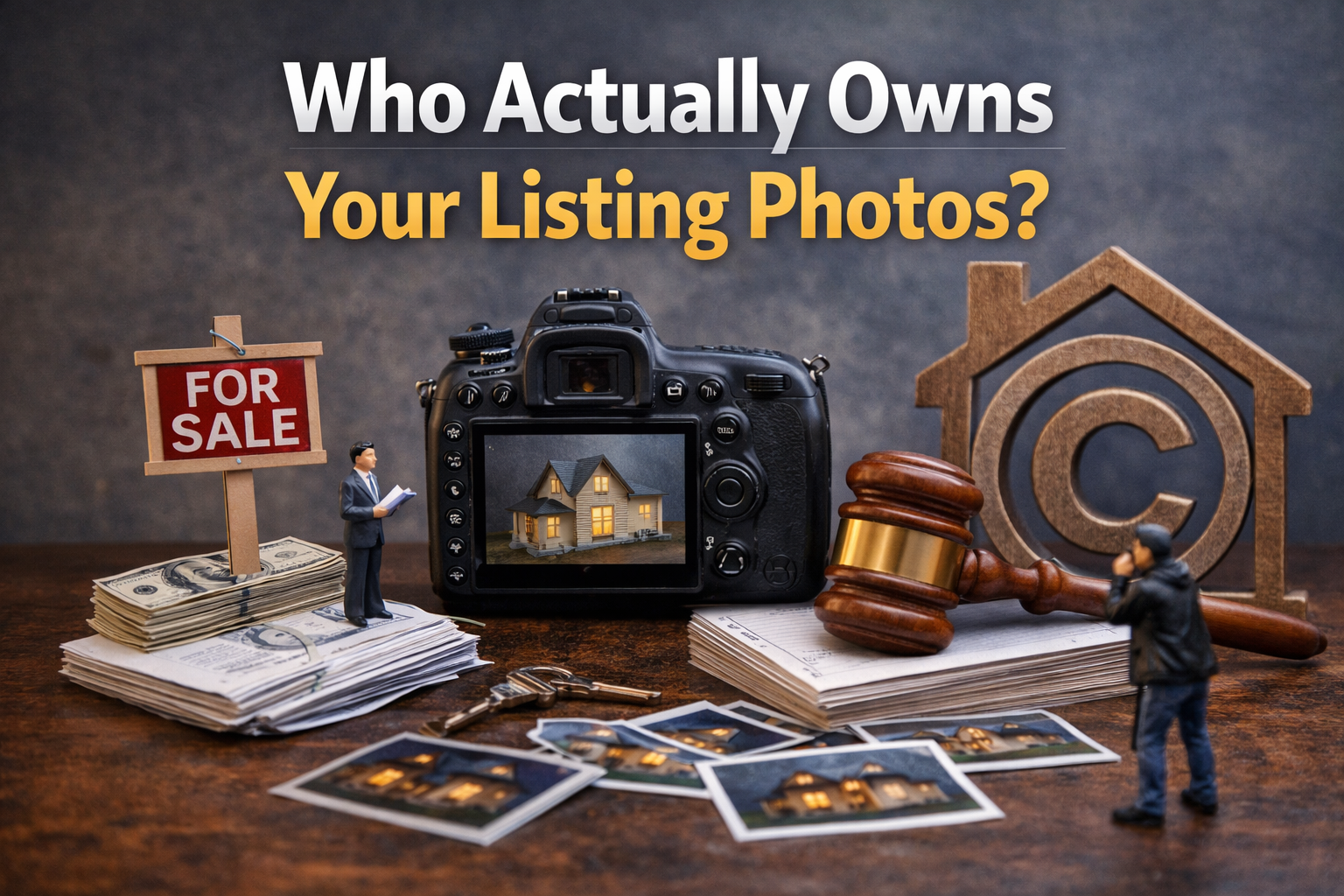
Who Actually Owns Your Listing Photos?
A Realtor’s guide to copyright, MLS rules, and avoiding expensive mistakes
The Short Answer
The creator owns the media. Not you. Not your brokerage. Not the MLS.
You’re getting a license, not ownership—unless a contract says otherwise.
No rights = no MLS upload. Period.
Editing, virtual staging, and AI = derivative use (you usually need permission).
Misuse can cost you—fines, lawsuits, and MLS penalties.
Who Owns Listing Photos, Videos, and 3D Tours?
Under U.S. copyright law, the person who creates the media owns it by default.
That means:
Photos → Photographer owns them
Video → Videographer owns it
3D tours / floor plans → Creator or platform owns them
👉 Paying for media does NOT transfer ownership.
👉 Unless it’s clearly stated in writing, you do not own the content.
What about “work for hire”?
Rare in real estate.
Applies mainly to employees or very specific contracts
Hiring a freelance photographer ≠ work for hire
Bottom line:
You’re almost always working under a license, not ownership.
What Your License Actually Lets You Do
Your rights come from your agreement—not assumptions.
Typically allowed:
MLS listings
Zillow, Realtor.com, IDX sites
Your website & marketing during the listing
Usually restricted:
Reusing photos for a new listing
Giving photos to another agent
Selling or transferring images
Heavy edits or alterations
Duration matters:
Most licenses are temporary—often tied to the listing lifecycle.
👉 Once the home sells, your rights may expire.
MLS Rules: What You Must Know
MLS policies are simple in principle:
1. You must have rights before uploading
You need:
Ownership or
A valid license
No exceptions.
2. MLS does NOT take your copyright
Common myth.
MLS requires a license to display and distribute
They cannot force ownership transfer
3. You’re responsible (not the MLS)
When you upload media, you’re saying:
“I have the rights to use this.”
If you’re wrong:
You can face fines
Listings can be pulled
You could be personally liable
4. MLS enforcement is real
Agents can report unauthorized use
You may have ~10 days to prove rights or remove content
Violations can escalate to legal action
Virtual Staging, Video, and AI — The Gray Zone
This is where agents get into trouble.
Virtual staging = derivative work
You’re modifying the original image.
➡️ You usually need explicit permission.
Even if “everyone does it,” that doesn’t make it legal.
Slideshows & video tours
Generally okay if your license allows marketing use
⚠️ Watch for:
Music licensing issues
Platform terms conflicts
AI edits (sky swaps, enhancements, etc.)
Still derivative.
➡️ Same rule: permission required
AI-generated images (from scratch)
Often not copyrightable (current U.S. stance)
You may not be able to protect or control them
Ethics matter just as much as legality
Under the REALTOR® Code of Ethics:
Don’t mislead buyers
Disclose virtual staging and AI edits
Show reality—not fantasy
👉 If it changes perception, you need disclosure
The Big Myth: “MLS Requires Ownership”
Not true.
MLS requires:
“You have the rights to use and distribute the media.”
That’s it.
Photographers keep ownership
Agents must secure proper licensing
MLS enforces compliance—not ownership
Best Practices (Do This Every Time)
✅ Always use licensed or original media
No Google images. No “borrowed” photos. No guessing.
✅ Get everything in writing
Your agreement should clearly define:
Who owns the copyright
What you’re allowed to do
Where you can use it
How long you can use it
Whether edits/derivatives are allowed
✅ Know your license limits
If it says:
“One listing only” → don’t reuse
“No edits” → don’t stage or alter
✅ Plan ahead
Need broader usage?
Negotiate it before the shoot, not after.
✅ Understand your MLS rules
Some require:
Photographer verification
License uploads
Specific disclosures
Know your system.
✅ Disclose edits and staging
Label virtually staged images
Don’t hide defects
Don’t misrepresent the property
✅ When unsure—ask
Ask the photographer
Or consult an attorney
Way cheaper than a lawsuit.
What Happens If You Get It Wrong?
MLS fines or suspension
Forced content removal
Copyright lawsuits
Up to $150,000 per image in damages
This is not theoretical—it happens.
The Bottom Line
Real estate marketing runs on great media—but that media isn’t yours by default.
The winning approach is simple:
Get permission
Know your license
Follow MLS rules
Be transparent with buyers
Do that, and you’ll stay compliant, protect your business, and build better relationships with the creatives you rely on.
Disclaimer: This is not legal advice. Laws and MLS rules vary. Always consult a qualified attorney or your local MLS for guidance.
